
La Plata County Probate Division
Probate in La Plata County is handled by the Probate Division of District Court. Colorado places probate matters in District Court outside Denver, and La Plata County is part of the Sixth Judicial District. The same courthouse system also handles divorce, child support, felony criminal, juvenile, adoption, civil, mental health, and water-related claims, but probate records have their own file types and access limits.
A probate file may involve the administration of an estate after death, a will lodged or admitted to probate, appointment of a personal representative, letters testamentary, letters of administration, notices to heirs and creditors, inventories, accountings, claims, orders, guardianship petitions, conservatorship petitions, or trust disputes filed in court. The Clerk of Court is the access point for case-file copies and certified copies.
Probate Division of District Court
Location: La Plata County Courthouse
1060 East Second Ave, Suite 106
Durango, CO 81301
970-247-2304
laplataclerk@judicial.state.co.us
Clerk window: Monday-Friday 7:30 a.m.-4:30 p.m., excluding state holidays
The Colorado Judicial Branch La Plata County trial-court page is the official local court source for courthouse notices and court access.
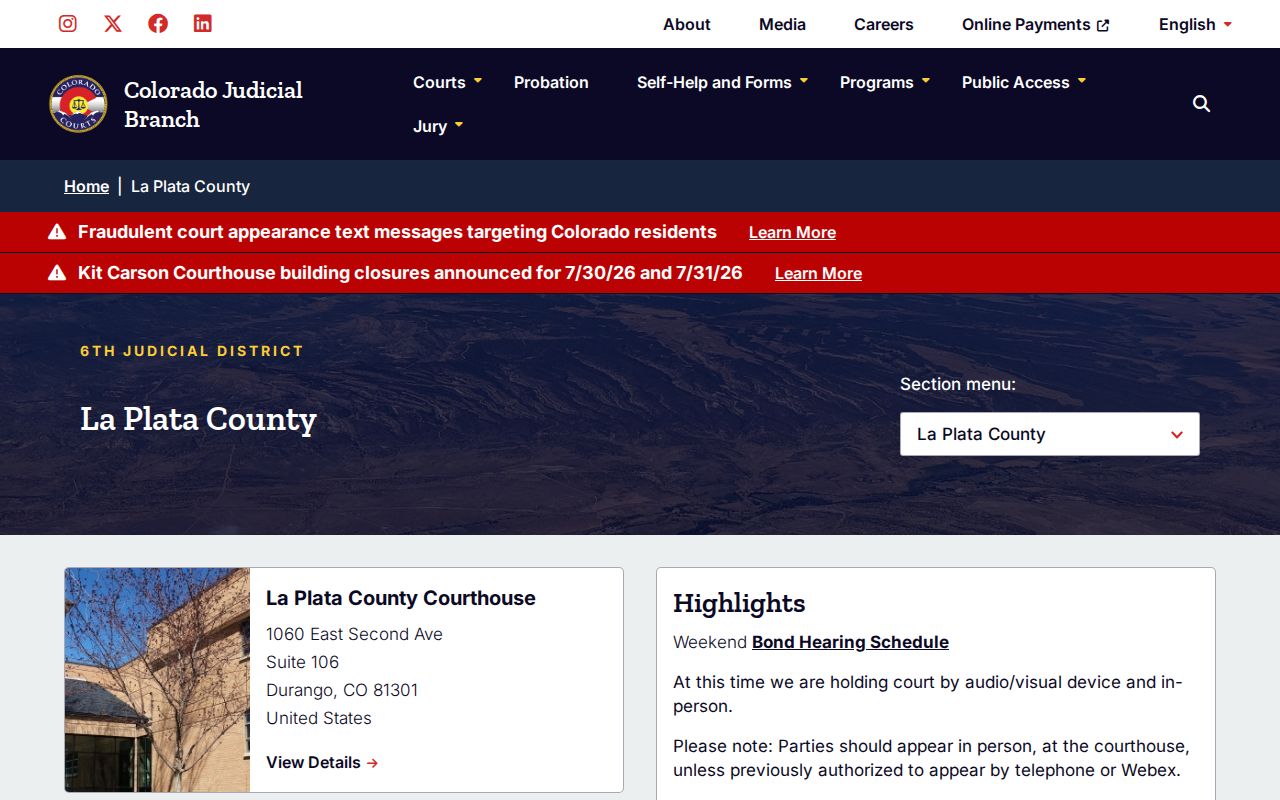
Use that court source for local court operations, then contact the clerk for probate copies.
La Plata County Probate Terms
Probate words are often brief labels in a docket or register, so definitions help before calling the clerk or reading a case entry. These terms describe roles, case types, and authority in estate and protection matters.
- Testator
- A person who made a will.
- Personal representative
- The person appointed to administer an estate; this role is often called executor in common speech.
- Intestate
- A death without a valid will controlling the property.
- Letters testamentary or administration
- Court-issued proof that a representative has authority to act for the estate.
- Guardianship
- A probate matter where a person is appointed to make personal-care decisions for someone unable to do so.
- Conservatorship
- A probate matter where a person manages another person's finances under court authority.
Search La Plata County Probate Records
Probate search starts differently from ordinary civil or criminal case data. CoCourts says probate case types are not included on its site, and it also excludes juvenile case types. Colorado State Courts Data Access contains court data rather than documents. The Judicial Branch Docket Search may help identify a scheduled public hearing, but probate case-file documents and certified copies require Clerk of Court access.
Older estate files may not be digitized. If a will, estate, guardianship, or conservatorship matter is not visible online, contact the Clerk of Court by phone, email, or in person. Provide the decedent or protected person's name, approximate filing date or death date if known, case number if known, and the specific document needed.
- Decide whether the record is an estate, will, guardianship, conservatorship, trust matter, or related probate order.
- Check the Colorado Judicial Branch docket for public hearing information if a date or case filter is available.
- Do not rely on CoCourts for probate because probate case types are excluded.
- Contact the Clerk of Court for file existence, copy rules, certification, and older file handling.
- Ask whether any part of the file is restricted or redacted before ordering copies.
The official courthouse location page lists the La Plata County Courthouse address and Clerk of Court contact.
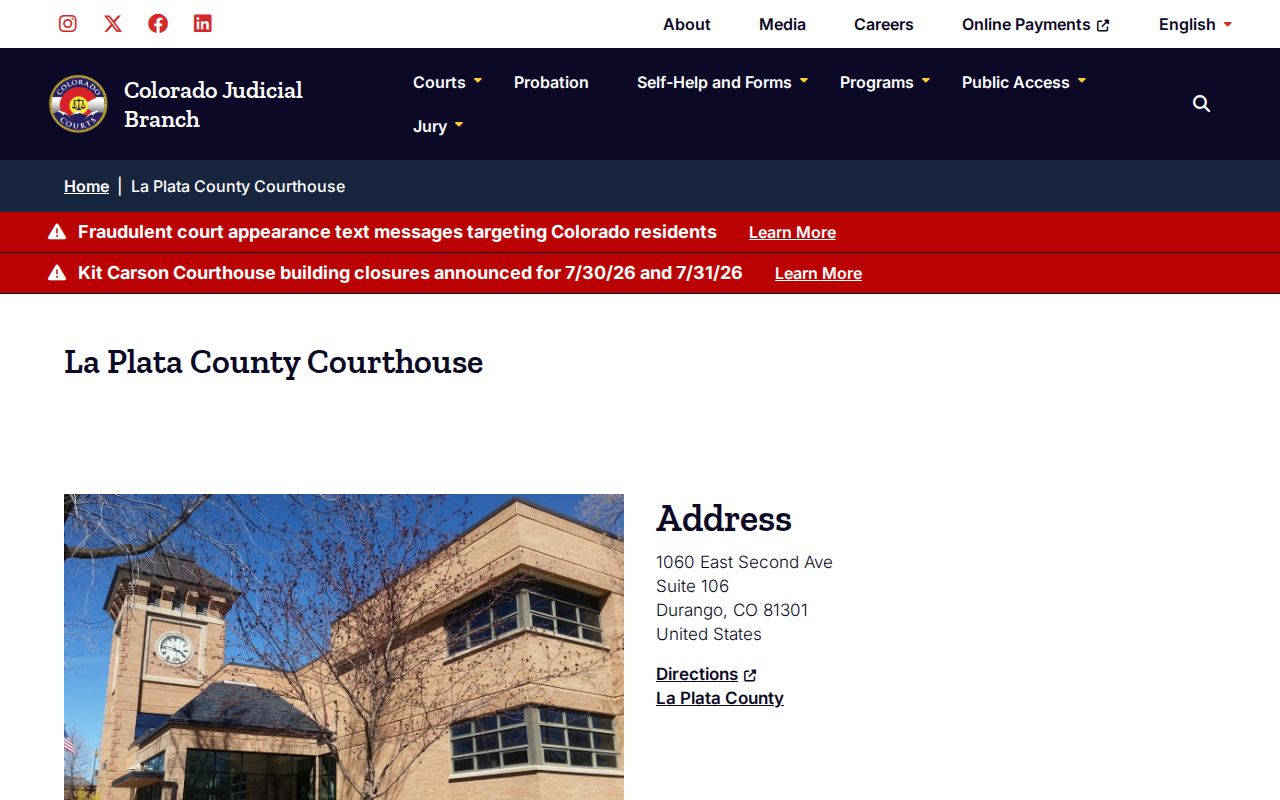
The courthouse listing is the right source for the clerk contact used for probate file requests.
What La Plata County Probate Records Show
Estate records can show a will, petition to open an estate, appointment of a personal representative, letters, notices, inventories, creditor claims, accountings, distribution orders, and closing orders. Guardianship records can show the petition, appointment order, professional reports where allowed, and annual reports. Conservatorship records can include financial reports, inventories, accountings, and orders.
| Probate record field | What it can indicate |
|---|---|
| Case number | The court file identifier used for clerk searches and certified copies. |
| Decedent or protected person | The person whose estate, guardianship, or conservatorship is at issue. |
| Petitioner | The person asking the court to open or act in the matter. |
| Personal representative | The appointed estate representative, if one has been approved. |
| Letters | Proof of authority to act for the estate. |
| Inventory or accounting | Estate or protected-person financial detail, sometimes restricted or redacted. |
| Orders | Judicial decisions appointing, approving, limiting, or closing the matter. |
Note: Guardianship and conservatorship files can contain medical, financial, and protected-person information that may not be open for general public inspection.
La Plata County Probate Access Limits
Estate case dockets and many filed orders may be public, but not every probate filing is open. Guardianship and conservatorship records may contain medical, financial, and identifying information. Minor guardianships, adoption-related matters, mental-health overlaps, sealed filings, and protected-person details may be restricted or redacted. The clerk can confirm what can be inspected and what must be requested by a party, attorney, or authorized person.
Colorado court records are governed by Judicial Branch access policy and court rules rather than the county recorder's ordinary recorded-document channels. Public-record requests for county administrative records do not replace a court copy request. If the probate matter involves a court order, certified letters, or a file document, use the Clerk of Court.
CoCourts exclusions are especially important here. A person may find civil, criminal, domestic, county traffic, or small-claims data in covered systems, but probate is called out as excluded. That means a missing probate result in CoCourts should not be treated as proof that no estate, guardianship, or conservatorship was filed in La Plata County.
Probate fees: The official research did not locate a current La Plata County or Colorado Judicial Branch probate fee schedule. Filing and certified-copy fees should be confirmed with the Clerk of Court before filing or ordering.
La Plata County Probate Process
A local probate matter usually begins by deciding whether the filing concerns an estate, will, guardianship, conservatorship, or trust matter. If venue is proper in La Plata County, the filer uses Colorado Judicial Branch probate forms in District Court, pays any required filing fee or seeks a waiver if eligible, provides required notices, and appears at hearings if the court sets them.
Estate administration often moves through appointment, notice, inventory, claims, accounting, distribution, and closing. Guardianships and conservatorships usually carry continuing reporting duties because the court supervises care or finances for another person. Certified copies of letters and appointment orders are often needed for banks, agencies, or property matters.
When a probate record affects land, the court file and the recorder file may both matter but for different reasons. The probate order or letters come from the court. A later deed, release, or recorded notice belongs to the County Clerk and Recorder. Searching both offices can be proper, but the request should name the record type so each office can route it correctly.
The county recording instructions cover recorded documents, not probate court files, but they help show the boundary between court probate records and non-court recorded documents.
Recorded deeds and liens are handled by the County Clerk and Recorder, while probate orders and estate files stay with the court clerk.
Public Record Search
Sponsored Results